
From their factory on Strada Abbadia di Stura in Turin, Aurora produces their own 14k and 18k gold nibs, their own ebonite feeds, and the proprietary Auroloide resin that gives Aurora fountain pens their distinct visual signature. Ironically, many Italian fountain pens are assembled from German parts. The nib may come from Bock or JoWo, not Aurora; this vertical integration sits at the heart of every Aurora pen the company ships, and it explains why serious collectors keep returning to the brand after stints with bigger names.
Aurora pens reward writers who value consistency of engineering over novelty of marketing. If you’re shopping in the four-figure range and want a piston-filled Italian writer with an in-house nib that performs out of the box, Aurora belongs on your shortlist, alongside other brands covered in our complete guide to Italian luxury fountain pens.
A Brief History of Aurora (Turin, 1919 to Today)
Textile industrialist Isaia Levi founded Aurora in 1919 in Turin, naming the company for the Roman goddess of dawn — a fitting choice for what would become Italy’s oldest continuously operating pen manufacturer.
The early Aurora pens followed the patterns of the era: hard rubber bodies, eyedropper or lever fillers, and gold nibs sourced before the company brought nibmaking fully in-house. Within a decade, Aurora was supplying pens to the Italian government, the Royal Italian Army, and an Italian writing public that had begun to treat the fountain pen as a marker of professional identity.
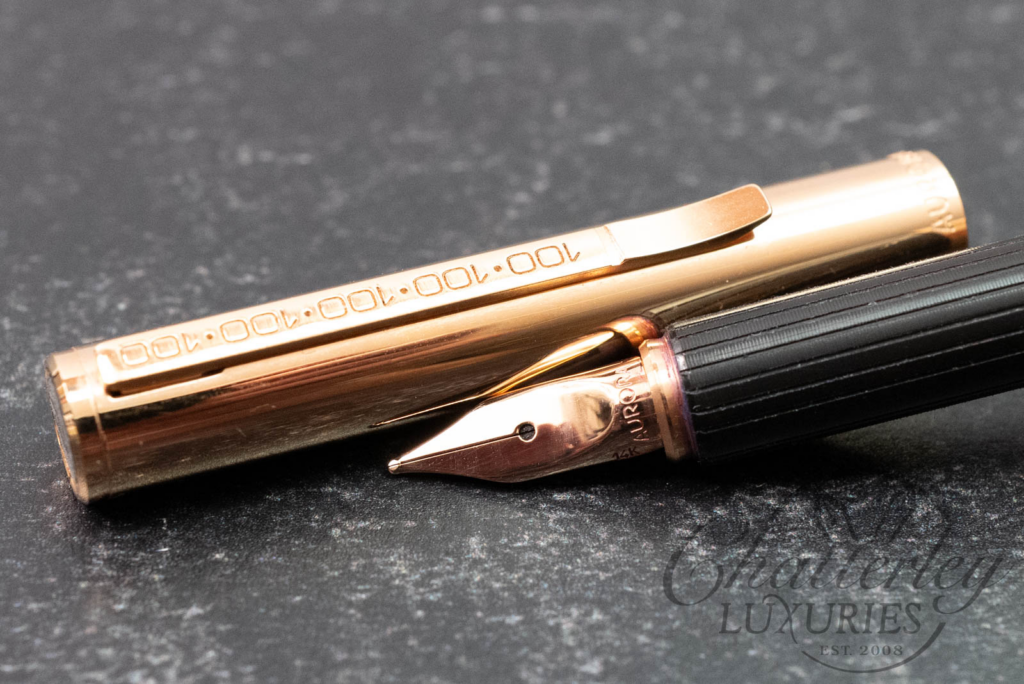
The company’s most-cited cultural moment came in 1970, when designer Marco Zanuso introduced the Aurora Hastil. The Hastil was a radically minimalist cigar of stainless steel or gold, with a hooded nib and no visible cap band, the kind of object that made every other pen on the desk look fussy. The Aurora Hastil even entered the permanent design collection of the Museum of Modern Art in New York, the first writing instrument to receive that distinction. For a brand sometimes overshadowed by its noisier neighbors in Bologna and Florence, the Hastil remains a quiet flex.
Between the Hastil and the modern lineup sit transitional pens like the Internazionale and the Duo-Cart, both of which kept Aurora solvent through decades when Italian penmaking nearly disappeared. The Verona family took ownership of Aurora in 1939 and still controls it today, which is part of why the catalog has the consistency it does. Trends come and go in Turin, but the family doesn’t gut the line every five years to chase them.
The Aurora 88: The Flagship
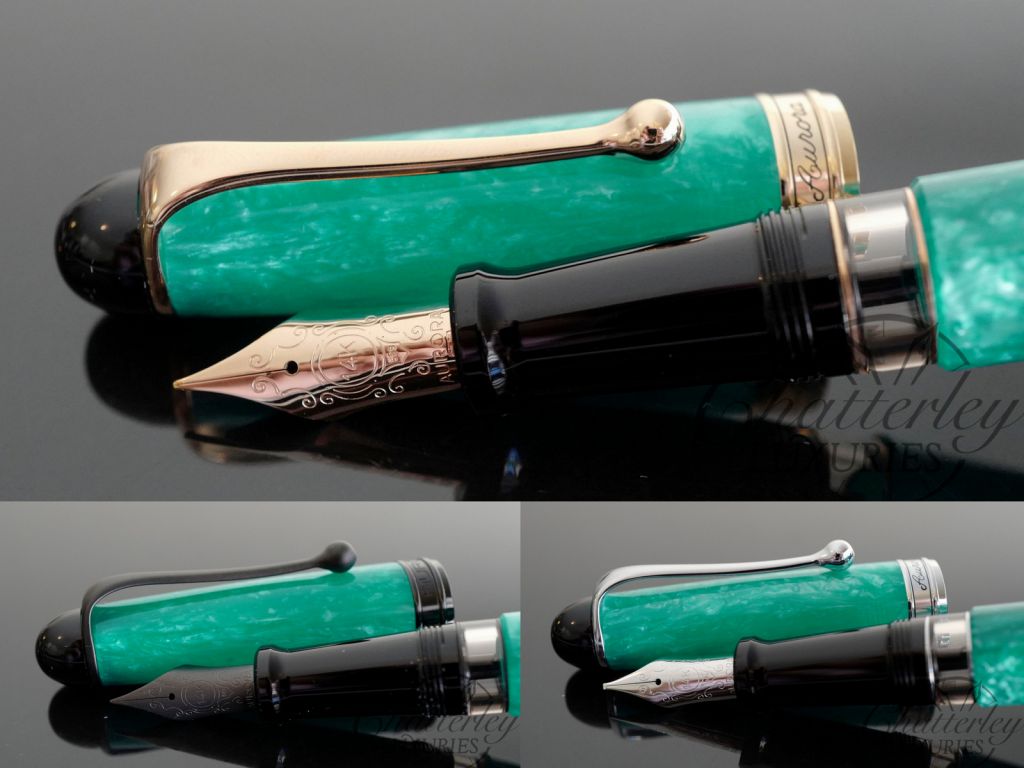
The Aurora 88, known in Italian as the Aurora Ottantotto, launched in 1947 under designer Marcello Nizzoli, whose other credits include the Olivetti Lettera 22 typewriter and the early Necchi sewing machines. The original 88 was a piston filler with a hooded nib and a slim torpedo profile, and its silhouette has barely changed in nearly eighty years. What’s changed is what’s underneath.
The current Aurora 88 fountain pen ships with an 18kt gold Nikargenta nib (Aurora’s own alloy, plated to a silver-white finish), paired with a reservoir feed that holds an extra meniscus of ink behind the nib for long writing sessions without flow drop. The piston runs on metal threads, the section grip transitions cleanly into the cap, and the build feels considered rather than assembled. The standard 88 comes in Auroloide (Aurora’s celluloid-style resin, hand-turned and patterned so no two barrels match) and in solid sterling silver versions that nearly double the weight in hand.
The 88 suits the writer who wants a substantial, full-sized desk pen with a piston filler and an in-house nib that doesn’t need a tuner’s bench to perform well out of the box. In my view, the 18kt nib ranks among the most pleasant factory nibs on the market: proportionally wet, and tuned with enough feedback to feel like writing rather than skating across the page. It satisfy anyone chasing the flex of a vintage wet noodle.
The collectible side of the 88 lives in the limited editions, and Chatterley typically has a few in stock. The Aurora for Chatterley Birth of Turin Collection Limited Edition 88 Fountain Pen is a Chatterley-exclusive collaboration commemorating the founding of the city of Turin, a small-edition pen built on the 88 platform that won’t appear in any other retailer’s case. At the other end of the visual spectrum, the Aurora 88 Ebonite Magenta Limited Edition Fountain Pen trades resin for vulcanized ebonite in a saturated magenta that photographs poorly and looks extraordinary in hand. Two different pens, same engine, same nib.
The Aurora Optima: The Pocket-Sized Workhorse
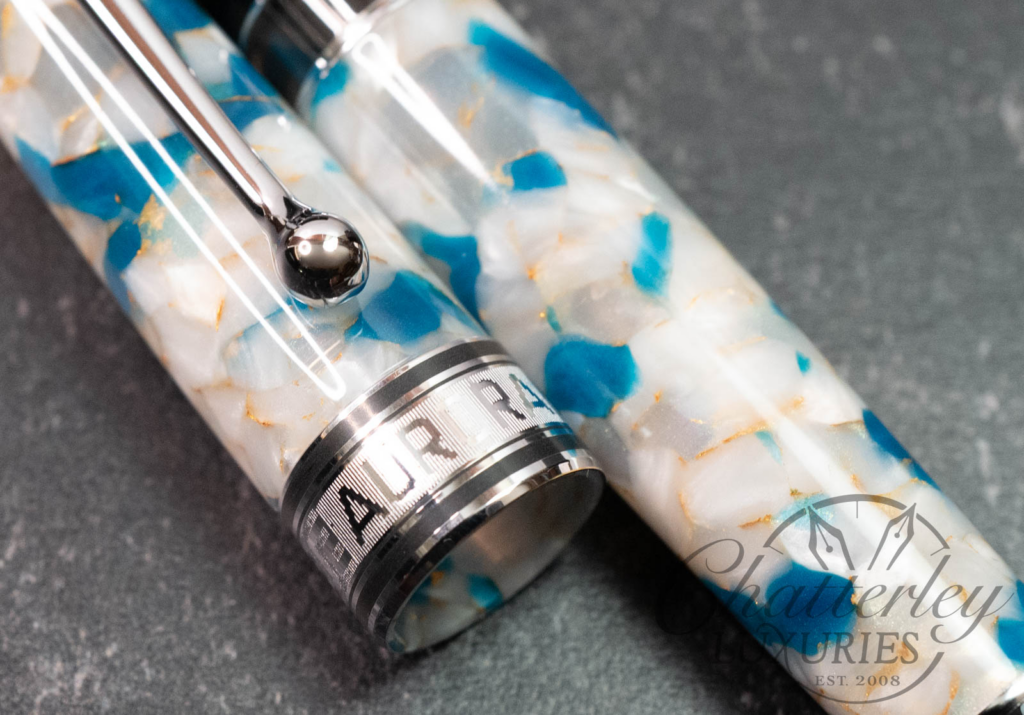
The Optima runs roughly fifteen millimeters shorter than the 88 capped, with a flat-ended profile and a snap-cap closure that posts deeply onto the barrel. Posted, it sits in the hand at almost exactly the length of the 88, which is why Optima loyalists describe it as an 88 you can put in a pocket.
The current Aurora Optima and 88 fountain pen uses the same 14kt or 18kt gold Aurora nib and the same piston-filling mechanism. The Aurora Optima Solid Sterling Silver Fountain Pen adds heft for writers who want a weighted pen that still posts cleanly, with a chased silver barrel that develops a patina over time rather than scratching the way a high-polish finish would.
Between the 88 and the Optima, the choice often comes down to one question: Do you prefer a flat top or round cigar top shaped pen?
The Aurora Talentum and Ipsilon: Entry Points to the Brand
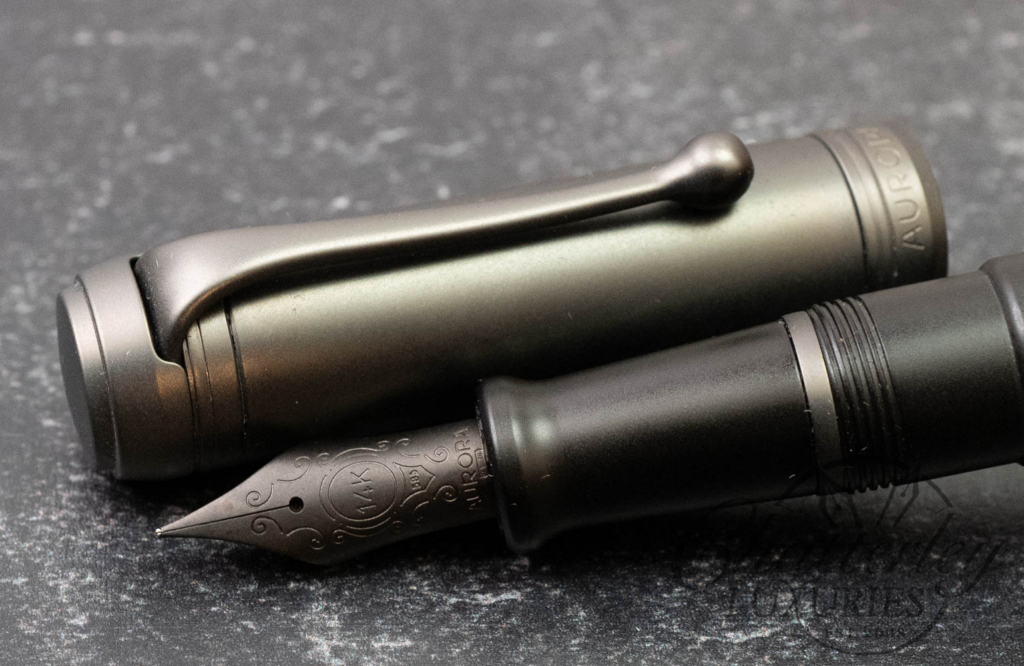
The Talentum and the Ipsilon are where new Aurora buyers often start. The Aurora Talentum carries a flat-ended cap, available in resin, ebonite, and rhodium- or ruthenium-trimmed metal finishes, and it uses a converter or cartridge rather than a piston. The current Talentum runs Aurora’s 14kt gold nib (with a steel option on the entry tier), which puts the writing experience meaningfully closer to the 88 and Optima than the price would suggest. The Aurora Talentum Black Ops Fountain Pen with Ruthenium Cap is a model we recommend to buyers who want a stealth-finish daily writer: matte black resin barrel, ruthenium-coated trim, and Aurora’s nib feel for several hundred dollars less than the 88.
The Aurora Ipsilon sits one step further down. The Ipsilon runs smaller, lighter, and more affordable, historically aimed at students and gifting. It typically ships with a steel nib (gold nibs appear on the higher-end Quadra and Deluxe variants) and a converter fill. The Ipsilon writes well for what it costs, but it may not convert a buyer into an Aurora collector the way the Talentum or the 88 will. If your budget allows the Talentum, take the Talentum. If it doesn’t, the Ipsilon makes a sound first Italian fountain pen and a defensible gift, but plan to upgrade.
Aurora’s Limited Editions: Why Collectors Chase Them
The 888 line turns Aurora owners into Aurora collectors. The name is literal: Aurora produces each Aurora 888 limited edition release in a strict run of 888 pens worldwide, and numbers each piece to match. The naming gives a triple nod to the standard 88 platform, the total limited count, and the lucky-number symbolism Aurora has used since the original 88 launched.
The 888 has become a primary vehicle for Aurora’s storytelling, with themed sub-series like the Planets (Sole, Marte, Saturno, Nettuno, Mercurio, Giove, Venere, Plutone, and onward) and the Secret Journey to Italy (Volterra, Ortigia, and others) sitting inside the 888 framework.
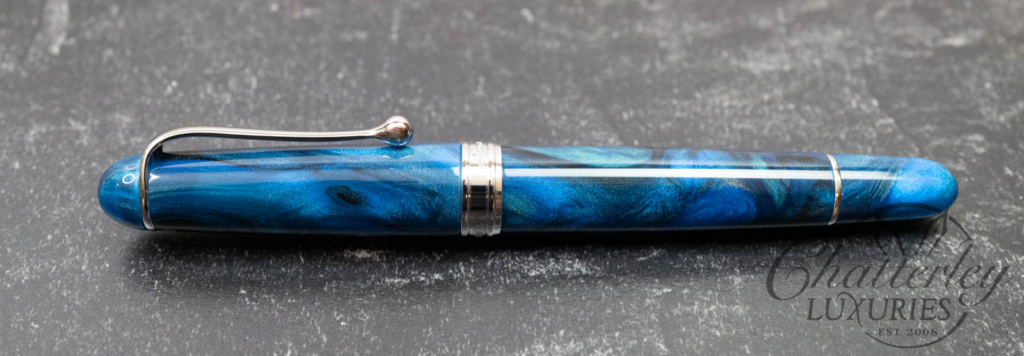
The Aurora 888 Boreale Limited Edition Fountain Pen represents the line well: an aurora-borealis-inspired Auroloide finish with precious metal trim, a numbered run of 888 pieces, and the 18kt gold nib carried over from the standard 88.
The Aurora 888 Labirinto di Villa Barbarigo Limited Edition Fountain Pen draws its visual language from the Veneto: green Auroloide turned to suggest the geometry of the hedge maze at the Villa Barbarigo, in the same 888-piece edition size.
Outside the 888 framework, Aurora produces a steady run of retailer and regional collaborations in much smaller editions. Chatterley-exclusive Aurora pens, like the Birth of Turin 88 mentioned earlier.
Choosing Your First Aurora
Three buyer profiles cover most people who buy their first Aurora fountain pen.
The desk writer who already owns a Pelikan M800 or a Montblanc 146 and wants an Italian counterpart could start with the Aurora 88 in Auroloide. The platform compares directly in size, the nib character runs more characterfully than either German option, and the 88 doesn’t share a desk awkwardly with a 146; they look like cousins.
The everyday-carry writer who wants something that posts cleanly, caps quickly, and fits in a shirt pocket should look at the Optima first.
The collector buying their first Aurora as an investment-grade piece should skip the standard line entirely and watch for an 888 release or a retailer-exclusive LE in the right finish.
Hand size and posting habits matter too. Larger hands and writers who post the cap tend to find the 88 sits more naturally; smaller hands and writers who prefer not to post often find the Optima fills the palm better unposted. For first-time buyers working with a tighter budget, the Talentum in a gold-nib configuration is the most sensible entry point. It carries enough of Aurora’s nib DNA to justify the brand badge, and it doesn’t feel like a stepping stone the way some entry-tier pens do.
A Closing Note
Italian penmaking has an incredible history in many cities! Bologna gave us Omas and, more recently, Scribo, both trading on a flexible-nib, celluloid-and-flourish tradition. Florence gave us Visconti, with its hook-safe clips and its appetite for unusual fillers. Naples gave us Delta and Leonardo. Turin gave us Aurora, and Aurora has spent a century being the steady one — fewer reinventions, fewer reboots, more pens that look in 2026 the way they looked in 1947. That consistency makes the strongest case for the brand. Browse the Aurora collection at Chatterley Luxuries for the current selection of Aurora fountain pens, or take a wider look at our full catalog of luxury fountain pens to place Aurora in context.